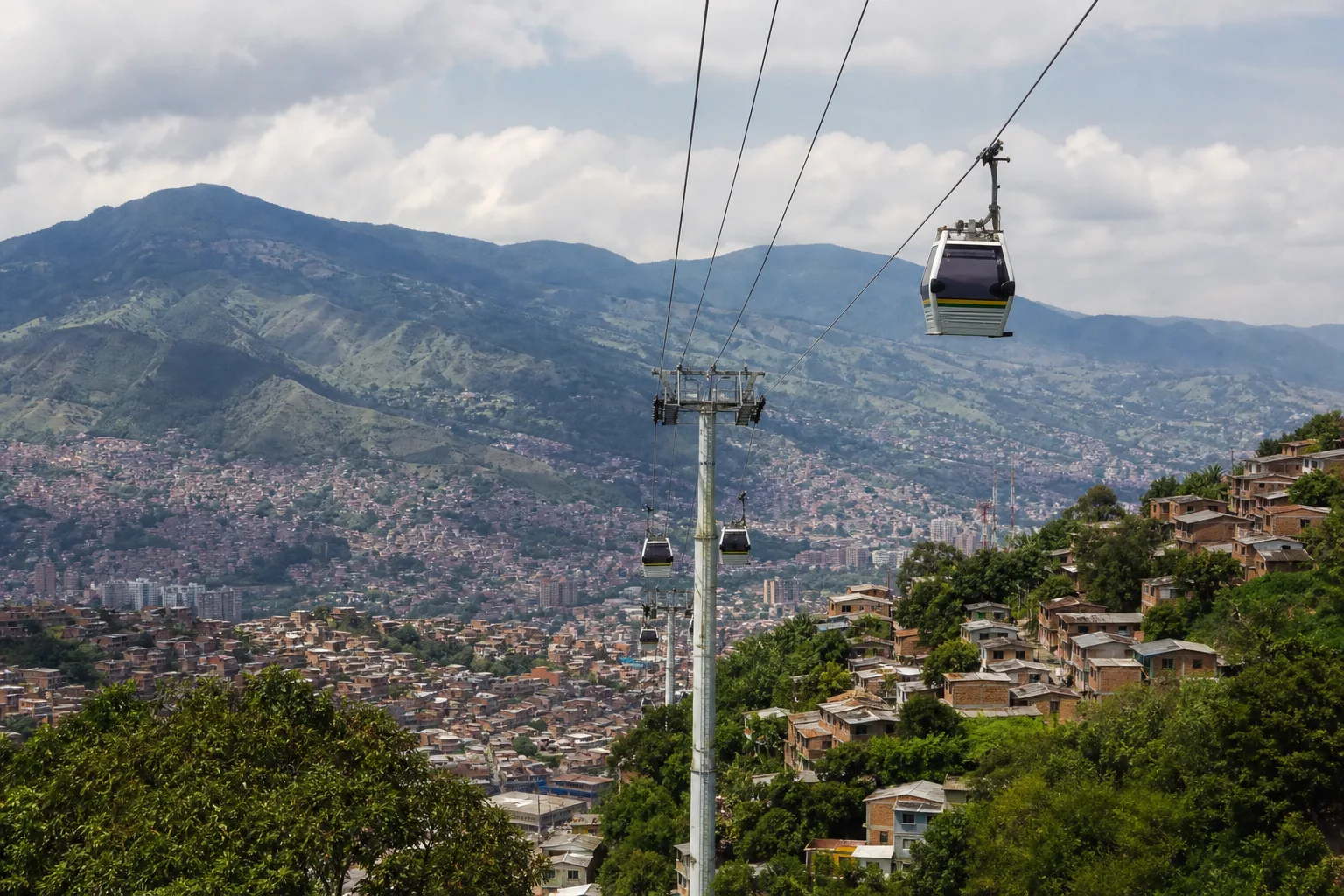
You can live in Colombia without a car if you learn the local logic. Between cities people take big coaches from the bus terminals. Inside the city it depends where you are: in Bogotá the star is TransMilenio (plus SITP city buses) on a TuLlave card; in Medellín it’s the metro, cable cars and tram on a Cívica card.
Fares go up almost every year, so treat the numbers below as a guide - check the board and the ticket window. One thing people underestimate: phones and bags get stolen on buses and platforms more often than in Uber. Keep them in front of you, especially at rush hour. More on that in Why Colombia and safety.
Between cities
The cheapest way from Bogotá to Medellín, Cartagena, Cali or Santa Marta is a day or overnight coach. Book ahead on redBus or Busbud - you see operators, times and prices. On site, tickets are sold at each company’s taquillas inside the terminal. You’ll often meet Expreso Brasilia, Copetran, Flota Magdalena, Bolivariano.
On overnight buses, sit closer to the driver and not by the door. Luggage goes under the bus with a tag - keep the receipt. Outside the terminal plenty of “helpers” push you toward “their” desk: walk to the official window inside the building or buy online.
Bogotá terminals
(Terminal de Transporte S.A., open 24/7):
- Salitre (main) - Calle 22C No. 68F-37 / Diagonal 23 # 69-11. The main hub for most destinations. Terminal Salitre page.
- Terminal del Norte - Calle 192 No. 19-43 (Usaquén, Autopista Norte). Handy for northern routes.
- Terminal del Sur - Calle 57Q No. 75F-82. Southern routes.
Official addresses and hours: Bogotá terminal locations.
Medellín terminals
(Terminales Medellín, operations 24/7):
- Terminal del Norte - Carrera 64C No. 78-580. Next to metro station Caribe (Line A).
- Terminal del Sur - Carrera 65 No. 8B-91 (Guayabal, by Olaya Herrera airport). Closer to the south of the valley.
Bogotá: TuLlave card
Without TuLlave you won’t get through TransMilenio or most city buses - turnstiles don’t take cash. Buy the card at any TransMilenio station (taquilla or punto de personalización) or an authorized shop - official steps: Cómo obtenerla | TuLlave. The plastic itself is about 8,000 COP (District rate); confirm on site.
Top up at the station, at kiosks with a TuLlave sticker, on tullaveplus.gov.co, or in the app. After an online top-up you sometimes still need to “activate” the balance on a pink validator inside the station - otherwise the card still feels empty. Operator overview: TransMilenio - Tarjeta TuLlave.
If you’re staying more than a couple of days, personalize the card (Plus): passport, cédula or PPT. Point list: puntos de personalización. You can start online and finish at a station window. You get cheaper transfers within roughly two hours, a couple of “credit” rides if the balance hits zero, and balance recovery if you lose the card. For a weekend visit a basic card is enough.
System site: transmilenio.gov.co. TransMi app - App Store and Google Play.
Bogotá: how to ride
TransMilenio isn’t a metro, but it feels close: long articulated buses in dedicated lanes, stations with turnstiles and boards in the middle of the avenue (often entered via a pedestrian bridge). How the network is built: SITP infrastructure (official). Tap TuLlave, walk through, pick your route and direction toward the right Portal. Letters like B, H, D, K plus a number are specific runs on a corridor - not every bus stops at every station, so check the map on the platform.
Board from the correct side, get off at your stop. With a personalized card, a transfer inside the time window often doesn’t charge a full second fare - that’s what the system is for.
Regular SITP buses (blue and red) run on ordinary streets. Tap when you board - by the driver or at the door. Routes are easier to find in Google Maps, Moovit or TransMi App. Buses are almost always packed and doors slam shut fast: don’t stand at the edge with your phone out.
There’s also TransMiCable - the cable car in Ciudad Bolívar. Same TuLlave, same payment system.
Bogotá: the main corridors
There aren’t classic metro lines here - there are troncales, corridors. Each one carries many lettered routes. Live maps: Mapa Digital TransMilenio and mapa interactivo. You’ll meet these most often:
- Av. Caracas - north-south through the center, one of the loudest and busiest.
- NQS (Norte-Quito-Sur) - the other big north-south spine.
- Calle 26 / El Dorado - toward the airport and west.
- Autopista Norte - north toward Usaquén and the northern portals.
- Calle 80 - west, Engativá.
- Av. Suba - the Suba area.
- Américas / Calle 13 - southwest, Kennedy.
- Eje Ambiental / Jiménez - centro and the historic core.
End hubs are called Portales - Portal Norte, Sur, 80, Américas, Suba and others. The network keeps growing - check the maps above before you go.
Medellín: Cívica card
Metro turnstiles don’t take cash - only Cívica. Official guide: How to travel in the Medellín Metro. For a short visit, buy an Eventual card at any metro station taquilla: plastic is about 10,000-11,000 COP, trip credit is separate. The fare is a bit higher than for residents, but a week is fine on it.
Staying longer? Get a free Personalizada at a PAC (Punto de Atención al Cliente). Per the Cívica Personal page, PACs are at San Antonio (two desks), Niquía, Acevedo, San Javier and Itagüí. Usually Mon-Fri about 9:30-18:30, closed weekends and holidays - confirm on site. Bring your passport. Rides are cheaper, you can recover the balance if the card is lost, and the system sometimes lends you one “credit” trip.
Top up at station windows, machines, city points, via Nequi / Bancolombia, or the Cívica app. Card site: civica.metrodemedellin.gov.co. App on Google Play and the App Store.
Medellín: metro, cables and lines
Medellín’s metro is one of the calmer rides in the country: clean, readable, less crushing than Bogotá buses. Buy Cívica, tap in. Transferring to a cable or tram means another tap; inside the integration window (~70 minutes) you usually pay once. Pick the line and terminus on the board, let people off, then board. Announcements are in Spanish; the maps make sense on the first try.
It runs roughly 4:30-23:00 on weekdays, shorter on Sundays and holidays - check live line status on metrodemedellin.gov.co. One fare covers metro, Metrocable, Tranvía, Metroplús and integrated feeder buses. The exception is tourist Line L to Parque Arví - separate and pricier (fares on the metro / Cívica sites).
How the network fits together:
- Line A - the main north-south valley spine (Niquía ↔ La Estrella). Use it for El Poblado, Industriales, San Antonio, Universidad.
- Line B - from San Antonio west to San Javier (Comuna 13 area).
- Tranvía T-A (Ayacucho) - tram east from San Antonio, then links to cables H and M.
- Metroplús (1 and 2) - BRT buses in dedicated lanes where there are no rails.
- Metrocable K - Acevedo → Santo Domingo (hills of comunas 1-2).
- Metrocable J - from San Javier into the western hills.
- Metrocable L - Santo Domingo → Parque Arví (the park above the city).
- Metrocable H, M, P - extra cables toward eastern and northern comunas.
Maps and line status on the metro site; live updates on @metrodemedellin.
Taxis and apps
Day to day most people install Uber, DiDi or InDriver and barely hail yellow taxis on the street. At the airport or outside a bus terminal, skip the guys shouting “taxi, amigo” - use an app or an official sitio.
If you do take a yellow taxi: ask for the meter (taxímetro) and pay cash in pesos. For airport or intercity transfers you can pre-book Kiwitaxi. At night or with suitcases, an app is usually calmer than any bus.
In short
Land in Bogotá - get a TuLlave at a TransMilenio station the first day, top it up, install Maps. In Medellín - Cívica at any station window; staying longer, personalize at a PAC (San Antonio, Niquía, Acevedo, San Javier, Itagüí). Between cities - redBus / Busbud or the operator desk inside the Terminal (in Bogotá usually Salitre). Keep the luggage tag. And yes: card and phone out of the back pocket.